Graduation Day June 1986
Graduation Day
Johnny, June 1986
Giulia’s not happy, which is a shame, because she looks terrific. She’s standing next to Zenon wearing orange shorts and a blue and orange SUNY New Paltz V-neck t-shirt. She found out she was accepted to the school last month and her mom had all this school paraphernalia mailed to the house. The colors are perfect for Giulia-the orange complements her strawberry blonde hair and the blue matches very nicely with her seashell eyes, just like in The Beatles’ song. She looks sexy, too—I’m pretty sure Mrs. Stringer had no idea the t-shirt was going to be that snug. If I had to pick a school for her just based on the outfit and the school colors, it would be New Paltz, although I’m not crazy about the fact that it’s a two-hour bus ride.
But that’s not my immediate problem.
“I can’t believe you did this,” she says. “I asked you not to do this.”
The expression on Giulia’s face is the one where she tries to hide her frustration and disappointment by being mad at me. I’ll admit, I’ve seen that face before, but, lately, more often,
now that this graduation issue is right around the corner. What are the odds that our graduation ceremonies would be on the same day at almost the same time? Pretty good, really, since there are only so many Fridays at the end of June. But still, it’s become a big deal. Or, I should say, I’ve made it into a big deal, since I insist on going to hers and not going to mine.
“Are you even listening to me?”
Needless to say, I’m not running up a particularly hearty score on my favorite pinball machine. Zenon’s not too happy, either. But she’s never that happy when Giulia’s around. She acts up—sometimes she shuts down out of the blue, or her voice gets staticky. Tonight Zenon sounds like she’s sulking. Her insults are half-hearted, like, why should I waste the good stuff on you if you’re paying attention to her, too? Four of the five women in my life are pissed off right now. Even my sister is mad at me, for upsetting Mary the Blonde, who she idolizes. Only my mother Elsie seems to be okay, but that’ll change, too, when she finds out that I’ve made up my mind not to pick up my award.
“I’m telling you,” I say to Giulia, after I screw up another shot. “Mary the Blonde’s not mad at you. Nobody’s mad at you. She’s mad at me. She says I’m ‘thick.’ That I don’t listen.”
“You don’t listen.”
“But I don’t understand why you’re getting so upset.”
“Because I don’t want your grandmother to think that I’m pressuring you to come to my graduation.”
“She knows that,” I lie.
“I don’t believe you,” she says. “I think she blames me.”
“She blames everybody. That’s her personality.”
“Maybe I’ll just go to your graduation,” she says, opening her eyes wider and shrugging her shoulders.
“You can’t do that,” I say.
“Why not? I never wanted to go to that torture chamber anyway.”
Giulia’s right—and not right. That day junior year, when she walked out, and I met her on the beach, and she told me she wasn’t going back—she meant it. She was dead serious. Even after we got together for the first time that beautiful April afternoon, she refused to change her mind about St. Joan’s. It took me a long time to convince her. Then we went back to school when it got dark and found her notebooks in the bushes under her classroom window.
But then senior year something clicked. Her grades got better, and she got a scholarship to this college with the terrific school colors. How are you going to argue with that? Her mom did what she thought was best when she pulled Giulia out of Tompkins. Even though it broke our hearts for
a while, it worked out pretty good for both of them in the end.
“What about your mother?” I say. “And that nun you like, Sister Domenic…”
“Sister Domenica,” she says. “Why do you insist on calling her Sister Domenic?”
“Because it’s funny,” I say.
“What about your mother? And your father. And Mary the Blonde. Poppy. Your whole family.” She looks over at the register, where Dinino and Ralphie are deep in conversation over a clam pie. The Temptations’ “Psychedelic Shack” is coming out of the transistor radio behind them.
“How are you going to let Ralphie graduate by himself?”
“I’m not,” I say. “He’s coming with me to yours.”
Ralphie looks over and gives us a thumbs up.
Giulia reaches for my hand on the flipper.
“Look,” Giulia says, “what you’re trying to do is incredibly sweet. And very thoughtful. But I’m a big girl. I’ll be alright at the St. Joan’s ceremony without you. Maybe my dad will show up—who knows? I’ll be fine.”
“I don’t think so,” I say.
“I don’t think so either,” she says. “But we’ll make it work. You can’t miss getting the award. You’ll hurt Ms. Favore’s feelings.”
Honestly, I didn’t think of that. Giulia sees me falter for a second.
“And then,” Giulia says, “we’ll all meet after and celebrate.”
The hint of a smile starts to work its way onto Giulia’s face, and she squeezes my hand tightly. I look out of the opening of the arcade that faces the beach. The boardwalk lights are crystal clear against the blue dusk coming down over the water. It’s like the sky is telling me to put all this other stuff out of my mind, at least for a little while. Especially now that Giulia’s lost the mad/ frustrated face and she’s looking at me the way she usually looks at me. All of a sudden, I get a vision of Giulia’s orange shorts around her ankles in the orange sand.
“Come on,” I say to Giulia, with a little look in my eye. “Let’s take a walk.”
“Forget it,” she says, and walks over to the register to grab a slice of pizza.
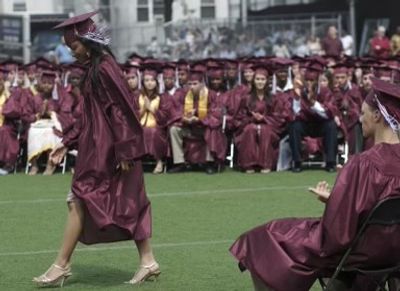
For the last couple of years, Tompkins has held its graduations on the football field, which is between the school and a white apartment building on the other side of the fence. The field always looks perfect, since our football team usually wins more games than it loses. They get a lot of attention, both the team and the field. The parents are herded through the gate on the street and around the Tompkins endzone into the aluminum football stands. It’s a pretty long walk, and I’m sure Mary the Blonde would love to say something about it. She hates exercise, even though she’s on her feet all day long in Lord & Taylor's, where she works as a store detective. But she’s happy for the moment, so she’ll probably let this one go, for now.
Principal Bertraum, Assistant Principal Denzler and the rest of the school hotshots are seated on a stage on the fifty-yard line facing the stands. The custodians set up the school banner across the front and placed red and white flower arrangements on the edge. Everybody on the stage is wearing suits or dresses. Ms. Favore looks especially summery in a yellow dress and a floppy straw sunhat.
The students, around four hundred of us, are sitting in our maroon graduation gowns on folding chairs to the right of the stage. The deal is, when they call your name, you get out of your seat, walk up to the stage, take your empty diploma case, walk down the other end and circle back to your seat. The deans and school security have their walkie-talkies ready for crowd control, but so far everybody looks like they want to behave themselves and wrap it up by noon before it gets too hot.
Right after the pledge, the school band plays the short version of “You Can’t Always Get What You Want”—interesting choice for a graduation song. Then AP Denzler announces that the guest speaker, one of our “esteemed” Staten Island councilmen, got sick and won’t be able to make a speech at today’s ceremony. All four hundred of us start applauding wildly—a lot of the parents, too. Principal Bertraum looks pissed off as hell. He stares us down for a couple of seconds, then mutters a few words into the microphone. Once he’s done, Bertraum motions for Denzler to introduce the salutatorian and then the valedictorian, two very nice kids that I never had too much to do with. Both of them give great speeches—funny, smart and short.
Denzler thanks them and then waves AP Simmons, the head of the Science Department, up to the podium to begin the awards portion of the show. As soon as he hands the mic over to AP Simmons, everybody starts applauding again. Out of all the supervisors, Ms. Simmons was always the nicest and most popular. Even if you were one of the students who could never tell the difference between meiosis and mitosis, she’d get you some tutoring and you’d be alright.
Ralphie looks down at my wrist and we synchronize our watches—10:22. We also synchronized our seats, calling in a few favors to rearrange our positions in the order so that we’re sitting next to each other. That’s going to create a few wrinkles when Bertraum calls the names for the diplomas, but by then it won’t make much of a difference, at least to us.
The idea came from Dinino. After Ralphie walked Giulia home the night she looked so hot in her SUNY New Paltz colors, Dinino waved me over to his stool.
“Pucchiacha,” he said. “I don’t understand you.”
I laughed. “I don’t understand me, either.”
“There’s an expression: Non puoi sederti su due sedie con un culo.”
When I shrugged, he spelled it out for me: “You can’t sit in two chairs with one ass.” He grinned. “You got that?”
“No,” I said.
“You try to make everybody happy, you make nobody happy. Capische? Make Giulia happy. She deserves it.”
“I know she does,” I said. “But Giulia’s right. Mary the Blonde expects me at graduation. My whole family does.”
Dinino closed his black olive eyes and shook his head. When he opened his eyes again, he said, “I’m not saying not to go to graduation…non stai ascoltando.”
“But if I don’t—”
He cut me off.
“Make them happy,” he said, “per un po.’”
“I don’t know if I could do that.”
“Testa di legno,” he says, pointing to his head.
When I look into the stands, I spot the Romanos immediately. I have to admit, they’re a pretty nice-looking group. They’ve all dressed up for the occasion, but they’re usually dressed very nicely anyway. My father’s wearing his light blue blazer and grey slacks. My mom is in a pale blue dress with padded shoulders—she looks like a prettier version of Crystal Carrington from Dynasty. Mary the Blonde wears one of her favorite Lord and Taylor shoplifting outfits—a mushroom brown pants suit. Even Poppy has a white and black check sports coat on. Michael, Jojo and Pamela are decked out in their cool school clothes. And of course, every one of them is wearing sunglasses.
Ralphie’s sister Mary is even easier to find than my family, thanks to the fur coat she’s still wearing. What surprises me is who’s sitting next to her.
“Is that Becker?” I ask.
“Yep,” Ralphie says. He’s a little more tight-lipped than usual, but I figure he’s just nervous about what we’re about to do.
“This creep is still hanging around?”
Ralphie leans close to me. “I think he loves her.”
“She’s sixteen,” I say.
“Yeah,” Ralphie says, “it’s not good.”
“I thought she was an angel again?” I ask.
“Very close,” Ralphie says. “But she still likes the bad boys.”
I get a very clear picture of the sonuvabitch standing in front of the Skee-Ball game with Joey C.’s arm wrapped around his throat.
“Becker’s not a bad boy. He’s a douchebag.” And then another really horrible thought strikes me. “Jesus,” I add, “does she love him?”
But Ralphie nods at the stage to stop me from talking. Ms. Favore just took the microphone and is standing at the podium. She’s like a fountain of sunshine against all those dark, boring suits. If it wasn’t for her, this whole acting thing might never have ever happened. Who am I kidding? There’s no way it would’ve happened. She pushed me into it, after we did a skit in class. I played the cabdriver Horowitz who talks to Holden about the ducks in The Catcher in the Rye. I used this gruff old man voice and she loved it. The whole class loved it. I still have no idea where the voice came from—when I opened my mouth, I was more surprised than anybody. After that, Ms. Favore would give me extra points on my grade to try out for the plays and show up for rehearsals. I had a little crush on her, too, especially sophomore year. That didn’t hurt, either.
Out of nowhere, I feel my eyes tear up.
“I’m very pleased,” Ms. Favore says, “to present the Excellence in Theater award to a student who will be attending NYU in the fall to study drama: Johnny Romano.”
I look over at my family, who are applauding enthusiastically, along with the rest of the crowd. Everybody’s clapping except for my grandmother, who’s staring at me like she knows something’s up.
“Let’s do this,” I say.
The two of us get up and walk to the side of the stage. I can feel people’s eyes on us, wondering why Ralphie’s going up there with me. Don’t worry about it, I think-- we’re right on the money. As soon as I climb the stairs, I feel like I’m in a dream sequence from a Fellini movie. Ms. Favore gives me the award, she hugs me and kisses me on the cheek, I wave to my classmates, there’s a lot of applause. It’s all taking place in slow motion, which is great, since, even though I’m in a hurry, I don’t want it to end. But when it does, Ralphie’s waiting for me on the other side of the stage.
“Well done,” he says.
I put my sunglasses back on, still buzzing from what just happened. I’m pretty sure Ms. Favore’s pink lipstick caught the corner of my mouth.
“Ready?”
Ralphie says, “I need a minute.” I follow Ralphie’s eyes—he’s looking at the stage as Mr. Ascher steps up to the podium and takes the microphone.
“It is my distinct honor to present the Excellence in English award to one of the finest writers, readers, and thinkers that I have ever had the pleasure to teach: Ralph Molinaro.”
Ralphie climbs the stairs to the podium. He shakes Mr. Ascher’s hand and takes the award. Neither one of them says a word. Then he climbs back down the stairs. The whole thing takes six seconds.
I’m laughing, even though a couple of the security guards are already waving at us to go back to our seats. But Ralphie is very serious. He points to Mr. Ascher, who has sat back down next to Ms. Favore.
“A superior human being.”
“Why didn’t you tell us you were getting an award?” I ask.
“I didn’t want to complicate things.”
The two of us tuck our awards under the arms in our gowns and I tug Ralphie away from the stage. As we start to walk toward the sideline, I hear the static from a few walkie-talkies behind us, along with a couple of “Heys!”
“Don’t look back,” I say, but Ralphie’s not listening. He’s slowed down halfway across the field and is looking up at the sky in every direction.
“Shame she couldn’t be here,” he says.
He's talking about his mom, who passed away from cancer in the middle of our junior year. I put my arm around his shoulder and look up at the sky, too.
“Who knows?” I say. "Don't count her out."
Mr. Fredericks, the meanest dean in the school, is yelling at us.
“Romano! Molinaro! Get back here.” He sounds like the warden at the end of The Longest Yard who’s screaming at the prison guard to shoot Burt Reynolds. We pick up the pace a little.
“That it?” I ask, pointing at a banged up, green and white car idling at a fire hydrant just outside the entrance to the field. All the windows are rolled down and there’s a wave of pot coming out of the front seat. The guy behind the wheel looks a little green and white, too, but he’s waving to us like we’re long-lost friends.
Ralphie waves back as we step through the gate.
“Holy shit," he says. “That's Frankie. My mother’s favorite driver.”
He breaks into a smile as I open the back door of the cab and we head off to see Giulia.
Welcome to the Arcade Chapter One
Johnny, September 1979
Whenever we come down to the arcade after school, Octavio can’t keep his eyes off Joey Colucci. I tell him, this is not a neighborhood where you want to stare at anybody, especially one of the local psychos, but Octavio claims he can’t help himself. He says he’s never seen anything like Joey C. in his life. And even though I grew up a few blocks from here and not on a military base like my friend, I tend to agree.
Joey C.’s body is enormous. It’s shaped like a giant stuffed shell and wrapped in an old army jacket that’s never buttoned, with the sleeves cut to show off his tattoos. Green, blue, gold and red flames flicker from his wrists up his arms to his neck, which is as thick as a snow tire. A pair of baggy dungaree shorts and blue flip-flops complete the picture.
There are all kinds of rumors about what Joey C. does. The one thing I know for sure is that every Fourth of July, he steals a car, fills it with M80s and gasoline and blows it up in the middle of the South Beach parking lot. Then he takes a bow and everybody watching from the boardwalk goes crazy. It’s the only time I’ve ever seen Joey C. smile. The problem is, on every day that’s not the Fourth of July, he stands on the corner in front of the Club Vino. We have to walk right past him to get to the arcade. And Joey C.’s definitely not smiling now.
“You think he was really in the army?”
“Sshhhh,” I say. Octavio always has a million questions, even when we’re not in school. He asks them in one of those squeaky whispers that slice right through the beach air and the voices of The Four Seasons singing, “Who loves you, pretty baby?” that come flying out of the open door of the bar.
“Why does he look at you like that?”
“Sshhhh,” I say again, trying to move him along. “Like what?”
“Like he wants to say something to you.”
“No way,” I say. “It’s the sunglasses.”
Along with all the other things that Octavio finds fascinating about him, Joey C. wears a pair of silver aviators. When the lenses catch the afternoon sun, they blind you like a death ray. Octavio blinks at him for another three seconds, then turns away.
“Maybe,” he says, but I can tell he’s not convinced. Neither am I, really. Joey C. does look at me funny, even with the mirrored sunglasses. But by this time, we’re close to the opening of the arcade. I check the dial on Octavio’s watch, which is as big as the lid on a coffee can and has six mini clocks that show time from navy bases all over the world. As far as I can tell, it’s not even twelve-thirty. We’ll have the place to ourselves for another hour and a half.
The arcade is on Sand Lane. It’s about fifteen feet from the Club Vino and Joey C. and next to what’s left of the small amusement park, which loses a ride every summer. (When they break down, like the Caterpillar did this past July, someone just covers them up with a tarp.) The arcade’s got huge colored letters in front that spell out A-R-C-A-D-E, so the tourists who used to come to the beach but don’t anymore won’t miss it. The building is nothing fancy, just a cement bunker with two walls missing, one facing Sand Lane and one facing the water. The other two walls are painted black and packed with video games.
Dinino, the man who owns the place, sits on a stool by the cash register twenty hours a day. He pulls the metal gates down when he closes up at night and pulls them up first thing in the morning.
Even with the openings and the mist, which comes off the water and sticks to everything in the neighborhood like salt on a pretzel, the arcade is always ten degrees hotter than anywhere else and smells like burning rubber. It’s only a matter of time before something blows. But we have the fire department up the block and the Atlantic Ocean a hundred feet away, so I think we should be good.
“Pucchiacha,” Dinino says when he sees us coming, and we wave.
Dinino’s maybe fifty, maybe a hundred and twenty. He’s one of those people that’s impossible to tell how old they are, mostly because of the layers of clothes (black coat, sweater, hat, pants, boots and white apron and socks) that he covers himself with every day of the year, no matter how hot or cold it is.
The five feet of Dinino start with his black felt hat and end with the rubber soles on his boots. I’ve never seen him wear anything else, and I’ve been playing games down here for seven years. When I was four, my grandmother Mary the Blonde walked me into the arcade, put me on a milkcrate in front of Whirlybird, and handed me a stack of quarters. Dinino’s been calling me “Pucchiacha” ever since. It’s an inside joke between the two of them. I know it’s Sicilian for something bad, but I’m not sure exactly what. Mary the Blonde says it’s better that way and laughs.
Because of my “needs to apply himself more” grades at Holy Calvary, I usually don’t get to the arcade during the week, but Wednesdays are a different story. Every Wednesday we get out of school at noon, so the church can funnel the public-school kids in after lunch and make some extra money. The nuns used to call it “Release-time,” only they stopped when parents said it sounded too much like prison. So now they call it CCD. Nobody knows what it stands for, but everybody’s thrilled, except for the poor PS 93 and PS 64 kids who have to sit in those hot classrooms until a quarter to three.
Our friend Artie’s already playing Skee-Ball when me and Octavio walk in.
“Another record, my friends,” Artie calls out, a huge grin on his face.
Artie’s very tall and thin—Mary the Blonde calls him “lanky” -- with long, skinny arms that almost reach the ball-hop. He’s really good at Skee-Ball, and if anybody deserves to be really good at something, it’s Artie Brown. Sometimes kids tell him he should be playing basketball with those long arms. But none of it fazes Artie. He just smiles and sails another wooden ball into the 50-hole. It’s beautiful.
The green cardboard tickets you get for having a high score are pumping out of the ticket dispenser near the coin slot. They curl up like an old hose on top of Artie’s bookbag, which he’s dropped on the floor in front of the game. The tickets are completely worthless-- you can redeem them for a comb if you have ten thousand of them--but the thought of getting them for doing something you like to do is a nice touch.
I nod at the tickets and then at Artie’s score and try to keep a serious look on my face. “Not bad for an orphan,” I say, and we both start to laugh.
Artie and I met in kindergarten and stayed best friends even after I was shuttled over to Catholic school for first grade. He ate lunch at my house for the whole year we were in PS 93 together. And even though I go to Catholic school now, he still eats dinner at our house at least twice a week.
He used to live at the Bethlehem Home, which was an orphanage run by Lutherans on a hill by the Verrazzano Bridge, not too far from where we live. Mary the Blonde would take me there on Saturday afternoons to play nok hockey with him, and it didn’t seem like a bad place at all. He went
into foster care when the home burned down a couple years ago. My family is so crazy about Artie that my mother wanted to take him in after the fire, but for some reason it never happened.
Octavio smiles at the pile of tickets on the bookbag, gives Artie a thumbs-up, then parks himself in front of the racing game. He’s about half the size of Artie, so he stands on his tiptoes and hangs onto the wheel like he’s heading into the last lap at Daytona. Octavio’s obsessed with cars, especially ones with nitro engines that need parachutes to stop.
The Borbo family is from the Philippines, but his father’s a mechanic in the U.S. Navy. They live in Fort Wadsworth, the base under the Bridge, but they’ve moved like eight times since he was born. He arrived in Holy Calvary two years ago, when we were in fourth grade, and we both know the clock is ticking. But for now, everything is perfect. It’s only when Phillip Becker walks into the arcade that our beautiful September afternoon turns to shit.
“Look who’s here,” Becker says. His beady eyes move from our grey school uniforms and Artie’s Hawaiian shirt and shorts to our annoyed faces. “Jerkoffs International.”
The good news about Becker is that we don’t see him a lot, especially now that he’s in high school. But whenever he does stop in the arcade there’s a problem, which comes down to one thing. It’s not that Becker’s the worst human being who ever turned up in South Beach. There are other bullies roaming these streets who are much more likely to knock you into a giant rose bush or twist your arm until you’re on your knees and then push your face into a pile of fresh dog crap. Becker is about as much of a physical threat as someone in a blue and white striped polo shirt can be.
What keeps us dreading Becker is that he has a big mouth. It’s full of nasty things that most of us know not to say and don’t really want to hear about anyway, especially when we’re in the arcade and all we want to do is play games. He also brags non-stop. He loves to tell us how good he is at everything and that everything he does and has is the best: he has the best arm in softball, he gets the best girlfriends, he has the best sneakers, he wears the best clothes, he has the biggest above-ground swimming pool you can buy. He even brags that he has the best braces. He was the same way when he went to Holy Calvary. He was a loudmouth then, only now that we don’t see him every day, he seems a lot worse.
Sometimes he pulls up to the arcade driving a yellow Trans-AM, even though he’s fourteen and he’s not even close to a license. Everybody knows it’s his older brother’s car, but he parks it up on the sidewalk for all the world to see. Some of what Becker says is true—he does have nice stuff. But it’s the way he says it. He goes out of his way to make sure everyone around him who doesn’t have all the stuff he has feels bad about it.
Like now.
“Watch out,” Becker says. “Let me show you how it’s done.”
Today Becker’s the best Skee-Ball player in the world and he’s not too happy when he sees Artie’s score. It doesn’t matter that there are four empty machines next to the game Artie was just playing. Becker has to play that game so he can wipe out what Artie’s just done. That’s what Becker does. My friend takes his hand off the wooden ball and takes a couple of steps back from the game.
“Come on, Becker,” Octavio says, “We know how great you are. Why don’t you try the arcade in the mall?”
“Why don’t I try your mother, Borbo?” he says. After Becker makes a few obscene gestures sliding his quarter in and out of the coin slot, he finally puts it into Artie’s machine. “Tell your mom it was good,” he says.
Dinino sits on his stool by the cash register. He sees everything but acts like he sees nothing. “Alert,” as Mary the Blonde would say. But from the way he leans forward I can tell what he’s thinking: “This f---ing kid again.” He’s not happy that Becker’s here. Dinino knows that Becker should be in school. But Artie should be in school, too, or at least in one of those hot CCD classrooms, so he doesn’t say anything.
After he shoots the first ball into the twenty hole, Becker’s mad. That’s the way he gets when things don’t go his way immediately. He steps back from the machine. “Take your garbage,” he snaps, and makes a face at Artie’s bookbag like it has leprosy. When my friend doesn’t move, Becker makes a show of checking his watch.
“Anytime you’re ready.”
I look at Becker and think about how happy the three of us were five minutes ago. Then, before Becker says something really stupid, I take a step toward Artie’s stuff on the floor.
“Chill Becker,” I say, “I got it.”
But when I go to pick it up, Artie grabs my elbow.
“Don’t,” Artie says. He looks at Becker with an expression on his face that I’ve never seen before.
Even though Artie’s always the tallest kid wherever we go, he’s the most peaceful person I’ve ever met in my life. He never gets angry, and he’s never in a bad mood. It’s probably one of the
reasons why my mother wanted to take him in so bad.
“They’re just tickets, Phillip,” I say. Becker hates when we use his first name. I don’t mention the bookbag, which looks suspiciously light anyway.
“You’re standing right there.”
“Shut up, Romano.”
"Make me."
“Fellas,” Dinino calls out from the stool, “what’s the problem?”
“Your customer won’t get his belongings out of my way.”
The way Becker says “belongings” makes it sound like a dirty word. And he doesn’t even look at Dinino when he says it. He just keeps staring Artie down. I feel my friend’s fingers press deeper into my skin.
“What’s the big deal?” Dinino says. “Raccoglili e basta.” Dinino looks down at the tickets and grins. “Non lasciare che questa bocca grande it dia fastidio.”
We’re used to Dinino speaking Italian to us and we can pretty much figure out what he’s saying by the way he says it, especially since it’s always followed by pointing and cursing. Artie looks at Dinino like he understood every word, but he still doesn’t move.
“I can’t,” he says to Dinino. “I’m sorry.”
Dinino nods at me and Octavio, who somehow heard what was going on over the roar of the car game and is standing next to us. Then he slides off his stool and grabs his broom and a dustbin, which he uses to pick up anything that falls to the floor, from a quarter to a piece of pizza crust. But Artie steps between Dinino and his stuff.
“He needs to hand them to me,” Artie says, nodding at Becker.
My friend’s standing stiff and straight, but his eyes look like two cups
of chocolate ice that have been sitting on the counter a minute too long.
“Like dick I will,” Becker says.
Dinino has the patience of one of the saints in the Bible who’s always getting hung upside down and hit with rocks but never loses his cool. But I can see that he’s had it. He puts his broom and dustbin back behind the register and turns his attention to me.
“Pucchiacha,” he says, “non fare niente do folle.”
Then an unbelievable thing happens—Dinino leaves the arcade. He turns and walks out of the opening and stands on the sidewalk in front of Becker’s brother’s yellow car.
“What’s he doing?” Octavio says.
But then something even crazier happens—he takes off his hat. So the double shock of seeing Dinino hatless and out of the arcade in the sunshine stops us all in our tracks. For about ten seconds the four of us stand shoulder-to-shoulder and stare at Dinino with our mouths open.
Becker snaps out of it first.
“This is fucking stupid,” he says, and immediately goes back to being an asshole.
But in that short time between us staring at Dinino with his hat off and Becker opening his mouth, I have one of those revelations that the nuns love to tell us about. I look at Becker and think: cuts from thorns heal. The smell of dog shit in your nostrils goes away. But this loudmouth, standing there in his polo shirt and his expensive braces, is about to do something worse than all the other lunatics in this neighborhood combined.
“Come on Phillip,” I say, “Just knock it off.”
“Stay out of this, Romano,” he says.
Octavio is thinking the same thing. Out of the blue he darts over to the Skee-Ball machine, scoops up the tickets and the bookbag, and puts them down on the floor behind us. But it’s too late. Becker finishes his sentence.
“That’s your business if you want to hang around with n------s.”
Once the word explodes out of Phillip’s mouth, Artie looks like he’s been punched in the heart. The melted ice in his brown eyes turns into tears. That’s when I barrel my head into Becker’s stomach.
It’s funny when you don’t know you’re going to do something until you do it, but here I am, my head buried in the stripes of Becker’s shirt. Unfortunately, even though I’m three months away from being twelve, I weigh eighty pounds with two pockets full of change, and it’s far from a major blow. Becker just kind of swipes me away like a bullfighter and I end up on the cement floor by the register. But it’s not me he wants to make miserable.
Anybody can take one look at Artie and know how much he doesn’t want this. When we were in kindergarten, Artie traded me his “Ball of Confusion” 45 for my “Let it Be” 45. That’s how much Artie doesn’t want this. But when Artie sees me sitting on the ground, my best friend rolls his fingers into two fists and steps toward Becker. Then they both stop dead in their tracks.
Joey C., his palms held out in the air like the world’s largest crossing guard, is suddenly standing between Artie and Becker, shadowed by Dinino, who’s put his hat back on.
“Basta,” Joey C. says, and everybody freezes.
He pulls off the mirrored sunglasses and slides them into the top pocket of the army jacket. He doesn’t look at me on the floor, or Octavio, or even back at Artie. Joey C.’s eyes, which are exactly like the yellow fins on the old pinball machine, zero in on Becker, who’s still standing next to the Skee-Ball game.
“I hear you’re pretty good,” Joey C. says.
Becker looks at him like he has no idea what he’s talking about.
Joey C. pats the top of the Skee-Ball game with his toaster-oven-sized hand. To his credit, Becker manages to get two words out of his mouth, a tremendous improvement from the last terrible word that left his lips.
“I’m alright,” he says.
Joey C. stacks a handful of quarters on the game by the ticket dispenser.
“Play.”
“I don’t feel like playing anymore,” Becker says.
“Sure, you do.”
Becker takes in the expression on Joey’s face. Then he slides in front of the table, puts one of Joey’s quarters into the slot and starts to play. The balls hit the jump and land occasionally in the forty hole, once in the thirty hole, but mostly in the hundred hole. Now Becker’s own tickets are sliding out and landing in a coil at his feet.
“I take back what I said,” Joey C. says. “You are very good.”
“Thanks.”
The sound that comes out of Joey C.’s mouth is not what I expected. His voice is gravelly, but the words come out steady and soft, not dangerous at all.
“No, I mean it,” Joey C. says. “Very, very good.”
Becker grins, like it’s the most natural thing in the world to get a compliment from a person who blows up cars.
“You know,” Joey C. says, nodding his head, “I got an idea.”
He pulls a wad of money the size of an artichoke out of his shorts and peels off three hundred-dollar bills.
“They’re yours,” he says, and drops them on the Skee-ramp.
“No,” Becker says, “I can’t take this money.”
“Sure you can--put it in your pocket. You deserve it.”
Becker, the cocky loudmouth that he is, thinks about it for a few seconds. Then he reaches for the bills and folds them neatly into the front pocket of his jeans.
“Thank you, Joey C.”
“Now, all you have to do,” Joey C. says, “is put the next ball in the hundred- hole.”
“What do you mean?”
“What I said.”
“You want me to put the next ball in the hundred-hole?”
“That’s all you gotta do. The ball goes in the hole, you keep the money. Done. You take your brother’s nice yellow car up to Carvel and you buy yourself some ice cream. Easy, right?”
Becker’s eyes move to the hundred-hole like it’s as big as the ocean and all he has to do is cross the street and drop it in. There’s no doubt in his head that he can make the shot. He picks up a wooden ball, sizes up his shot one last time—and winks at Joey. That’s when Joey C. leans in and puts his flaming tattoos in a V around Becker’s neck like a three-hundred-pound anaconda.
“But,” he says, “just so you know, if you don’t hit the hundred on the first try, I put you in the hospital. I take you behind the building and break every bone in your body. Especially your mouth.” Joey C. delivers these words in the same soft and steady way he’s just praised Becker’s game. “You deserve that, too.” And he releases his hold.
It’s obvious from the terror on Becker’s face that the hundred-hole has shrunk from an ocean to the size of one of those paper cups you rinse with in the dentist’s office. He reaches into his jeans, slides the three hundred dollar bills out and hands them back to Joey. But when he turns to leave, Joey C.’s giant body blocks the opening to the arcade.
“You forgettin’ something?” Joey C. asks.
By now Becker can’t think straight. He looks from Joey’s face to the bills in Joey’s hand, desperate to figure out what he might be forgetting.
“Get your tickets off the floor,” he says, then looks at us like he just remembered we’re there. “So these boys could play.”
Becker spins around, grabs his tickets and darts past Joey. The Trans-Am bottoms out when he pulls it off the curb, but Becker doesn’t stop. Joey C. watches the Trans-Am race up Sand Lane from the opening of the arcade. Then he turns around and looks at me.
“You’re Jack Romano’s son, right?”
I’m in the same spot I was when I charged Becker, only now I’m standing.
“Yes,” I say.
“What’s your name?
“Johnny.” Then I add stupidly. “Romano.”
“Your father’s a great man,” he says.
I have no idea what he’s talking about. My father owns a vending machine business. At night he refills cigarette machines and swaps records out of jukeboxes. Most of the time when we’re home—“we” meaning my mother and my twin brothers and sister—he’s taking naps. When would he
have time to be a “great man’?
“The best,” Joey C. adds.
Is this a test? I hope not, because I suck at tests. But I can see by the way that Joey C. is looking at me that he’s serious. So there’s no way I’m going to argue with him. After what I just saw, if Joey C. tells me my father was one of the apostles, I’d run back to Holy Calvary and let the nuns know my father was at the Last Supper.
“Thank you,” I manage to say.
From the way he nods his head, this seems to be the answer he wants.
“Make sure you tell him I said hello.”
“Should I tell him what happened?”
“Nah,” he says. “Just hello.”
All of a sudden, the tattoos on Joey C.’s arms start to glow like they’re on fire. I’m so nervous I can’t help sounding like an idiot.
“I should say, ‘Joey C. says hello’?”
“Something like that.”
We all watch Joey C. take the remaining quarters off the Skee-Ball game, drop them into his shirt pocket, and put his silver sunglasses back on. Then he lumbers out of the arcade back toward the bar, waving at Dinino without turning around.
In a second Artie and Octavio are next to me. Artie is still a little wet-eyed, but he looks relieved. Octavio looks like Joey C. just blew up one of his favorite nitro cars.
“What just happened?” Octavio asks.
“I don’t know.” I look at Dinino, who’s watching us, his face as expressionless as the grey concrete floor. Then I point at one of the spinning dials on Octavio’s watch. “Come on,” I say, trying to put it out of my mind. “I think we still have an hour.”

Welcome to the Arcade
Welcome to South Beach, Staten Island, a seaside neighborhood under the shadow of the Verrazzano Bridge and across the bay from Brooklyn’s Coney Island. It’s the early 1980s, and best friends Johnny Romano, Ralphie Molinaro, and Giulia Stringer are trying to figure out their lives. But that’s not always easy in South Beach, a place where memories are long, questions are discouraged, and the past washes up faster than the ocean’s waves. Welcome to the center of their universe, a run-down cement bunker filled with video games across the street from the boardwalk, where the three friends eat pizza, play pinball and share their secrets and dreams under the watchful eyes of Dinino, the mysterious owner of the arcade. Welcome to the people who change their lives, as Johnny, Ralphie and Giulia make their way from grade school through a decade full of wonder and confusion, love and heartbreak, betrayal and redemption, and, always, the power of friendship. And welcome to the one question in their hearts and minds that can’t be denied: How do we solve the greatest mystery of all—growing up?
Welcome to the Arcade, the prequel to Two Nickels.

